
US Dollar’s Growth Pauses: Fed Meeting Outcomes and New Macroeconomic Risks for the Week
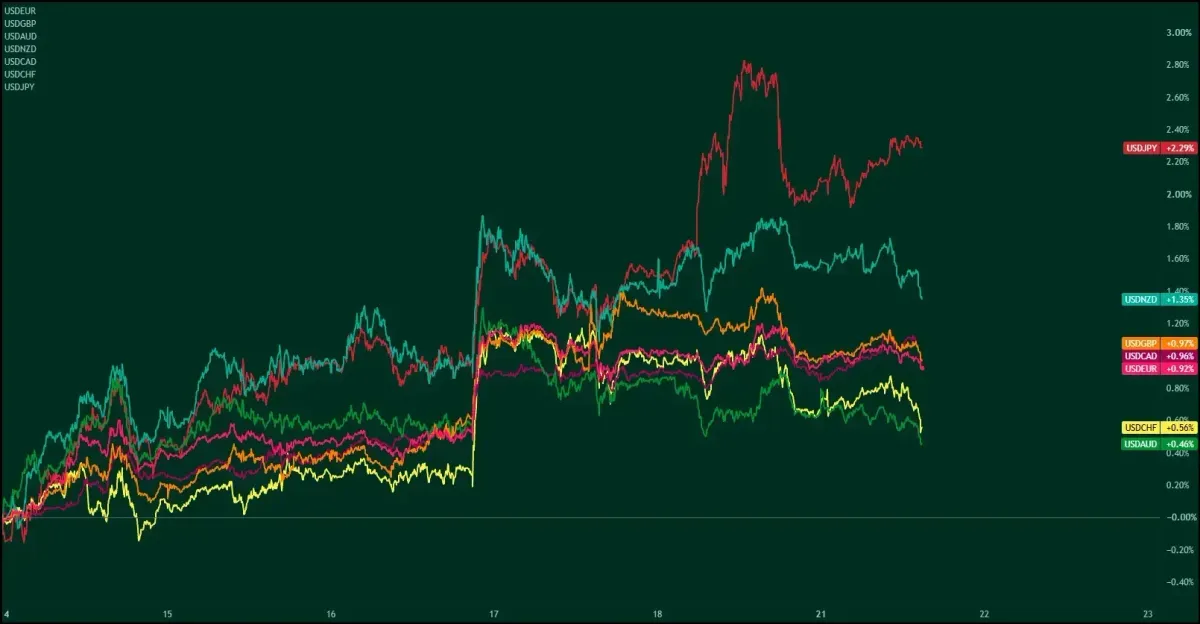
The past week delivered a strong bullish impulse to the US dollar, raising market expectations regarding the Federal Reserve's monetary policy. The primary drivers behind the greenback's rally were the outcome of the Federal Reserve meeting and robust retail sales data. Investor focus now shifts to this week’s developments to gauge whether the USD can maintain its momentum or if it will enter a correction.
Last Week’s Takeaways: Hawkish Fed Signal and Retail Sales Jump
The key event of the week was the September Federal Open Market Committee (FOMC) meeting, where the central bank raised its benchmark interest rate by 25 basis points—its first hike since 2023—bringing the target range to 3.75%–4.00%. Fed Chair Kevin Warsh took a distinctly hawkish stance, emphasizing that inflation remains too high and has lingered at elevated levels for too long. According to the updated macroeconomic projections, headline inflation (PCE) is expected to reach 3.7% by the end of 2026, pushing the return to the 2% target further into the future. Market participants are pricing in prolonged tight monetary conditions and a potential rate plateau with no near-term easing in sight.
The US currency received additional support from Retail Sales data. The indicator showed a strong rebound, jumping from -0.5% to 1.2% month-over-month, with steady annual growth at 6%. The main growth drivers were rising motor fuel prices driven by energy shocks, alongside resilient household consumer spending supported by a stable labor market. The combination of a hawkish Fed step and a resilient consumer created a textbook foundation for the dollar rally.
This Week’s Agenda: Fed Speeches and PMI Data as Inflation Persistence Indicators
The coming week promises to be equally event-filled for the FX market, requiring traders to pay close attention to incoming signals from the US.
- Speeches by Key Fed Officials: Keynote addresses from central bank leadership will take center stage. Tuesday features speeches by New York Fed President John Williams, Fed Vice Chair Philip Jefferson at the Treasury Market Conference, and Richmond Fed President Thomas Barkin. On Wednesday, Fed Governor Michael Barr will speak on the housing market. On Thursday, Barkin continues his series of appearances in a fireside chat at the Economic Club of Washington, joined by Cleveland Fed President Beth Hammack and Chicago Fed President Austan Goolsbee. The tone of these speakers traditionally sets the direction for short-term Treasury yield expectations.
- Purchasing Managers’ Indices (Flash PMIs): On Wednesday, the market awaits the release of preliminary S&P Global business activity data. Consensus estimates place the S&P Global Services PMI at 56.0 and the Manufacturing PMI at 53.4. The service sector remains in focus as the primary barometer of domestic inflationary pressure. Sustained high readings well inside expansion territory (above 50) would confirm that the economy is not cooling sufficiently and that inflation remains persistent.
- Additional Benchmarks: Consumer inflation expectations from the University of Michigan Index remain an important background gauge: short-term (1-year) expectations are projected at 4.6%, while long-term (5-year) expectations hold steady at 3.4%. Institutional investors view these metrics as indicators of how well inflation expectations remain anchored amid Fed tightening.
The current fundamental picture leaves the market with a key question: Can the incoming wave of data extend the greenback’s upward trend? On one hand, a hawkish Fed under Warsh and solid retail sales figures demonstrate that the US economy has enough stamina to absorb a 4% interest rate. On the other hand, much will depend on whether PMI prints and comments from Williams and Barkin confirm the regulator's commitment to an aggressive stance—or if the market has already fully priced in the peak of monetary policy tightening.