
FX Market Review: Past Week's Results
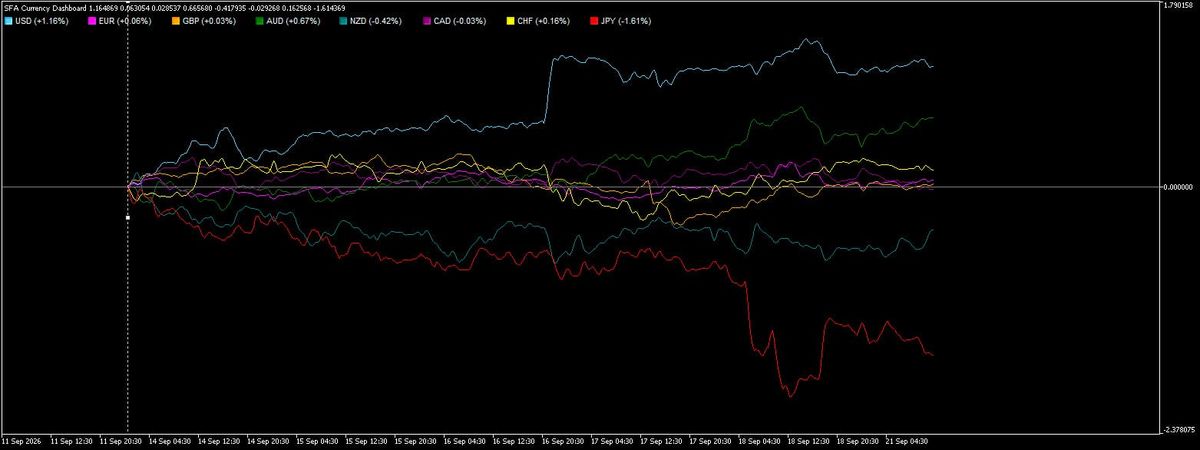
The past week proved to be exceptionally event-driven. The primary market catalysts were central bank interest rate decisions—specifically meetings by the US Federal Reserve, the Bank of England, and the Bank of Japan—alongside major statistical releases on inflation and consumer activity across leading global economies. The published data establishes a clear trajectory for currency indices in the near term.
Weekly Currency Index Performance
By the end of the week, currency indices posted mixed results:
- USD (US Dollar): +1.16%
- AUD (Australian Dollar): +0.67%
- CHF (Swiss Franc): +0.16%
- EUR (Euro): +0.06% (virtually flat)
- GBP (British Pound): +0.03% (virtually flat)
- CAD (Canadian Dollar): -0.03% (virtually flat)
- NZD (New Zealand Dollar): -0.42% (weakened as a currency negatively correlated with the USD)
- JPY (Japanese Yen): -1.61% (the week's main underperformer)
United States
The US Dollar delivered a strong performance, driven by a combination of robust consumer data and a hawkish stance from the central bank:
- Retail Sales: Showed a noticeable rebound, accelerating to 1.2% MoM compared to -0.5% in the previous period.
- Fed Interest Rate Decision: The FOMC unanimously raised the benchmark interest rate by 25 bps to a range of 3.75%–4.00%. Federal Reserve Chair Kevin Warsh struck a distinctly hawkish tone, stating that inflation remains too high for too long. The central bank signaled a commitment to keeping monetary policy tight for an extended period ("higher for longer") to ensure inflation returns to its 2% target.
United Kingdom
The UK economy is showing signs of overheating, which was reflected in both macroeconomic statistics and the MPC voting split:
- Inflation (CPI): Annual CPI rose from 2.9% to 3.1% in August. Monthly CPI increased from 0.3% to 0.5%, while Core CPI picked up from 0.2% to 0.3% MoM.
- Retail Sales: Accelerated to 2.4% YoY (up from 1.2%) and +0.5% MoM (rebounding from -0.5%), confirming resilient domestic demand.
- Bank of England Decision: The BoE maintained its key policy rate at 3.75%. However, the Monetary Policy Committee (MPC) vote was split: 6 members voted to pause, while 3 hawks voted for an immediate 25 bps hike to 4.0%. While the central bank remains on hold, it clearly indicated that if secondary inflationary pressures persist, a targeted hike to 4.0% remains on the table.
Eurozone
Eurozone data pointed to accelerating inflation, though the Euro remained largely neutral:
- CPI Headline: Annual inflation rose from 2.9% to 3.2%, with the monthly figure bouncing back from -0.2% to +0.4%.
- Core CPI: Monthly core inflation ticked up from 0.0% to 0.2%.
Canada
In contrast to Europe and the US, Canadian inflation figures pointed to a slowdown:
- CPI Headline: Annual CPI remained unchanged, while the monthly figure slowed from +0.5% to -0.1%.
- Core CPI: Monthly core inflation also eased from 0.2% to 0.1%, confirming a decline in price pressures.
Japan
The Japanese Yen led losses across the board despite the central bank's policy adjustment:
- Inflation (CPI): Headline CPI remained flat at 1.9% YoY, while the monthly rate slowed from 0.5% to 0.1%. Core CPI also dipped from 1.8% to 1.7% YoY.
- Bank of Japan Decision: The BoJ raised its key interest rate, but the path for further policy tightening remains highly uncertain given the lack of accelerating inflation. The market reacted with aggressive Yen selling following a classic "sell the fact" dynamic—once the long-awaited meeting concluded without hawkish surprises, investors moved to offload the currency.