
The Dollar Is Still High — When Will It Correct?

The dollar continues to hold at its all-time high of 102.36 DXY. Since September 9, it has already strengthened by 3.8%. This strengthening was fueled by the Fed's rate hike, Warsh's hawkish rhetoric, and, of course, rising US bond yields.
The US dollar index (DXY) historically follows the 10-year US yield, which has soared to a historic high of 5.32% over the past two months.
Chart 1: DXY and US10Y dynamics comparison.
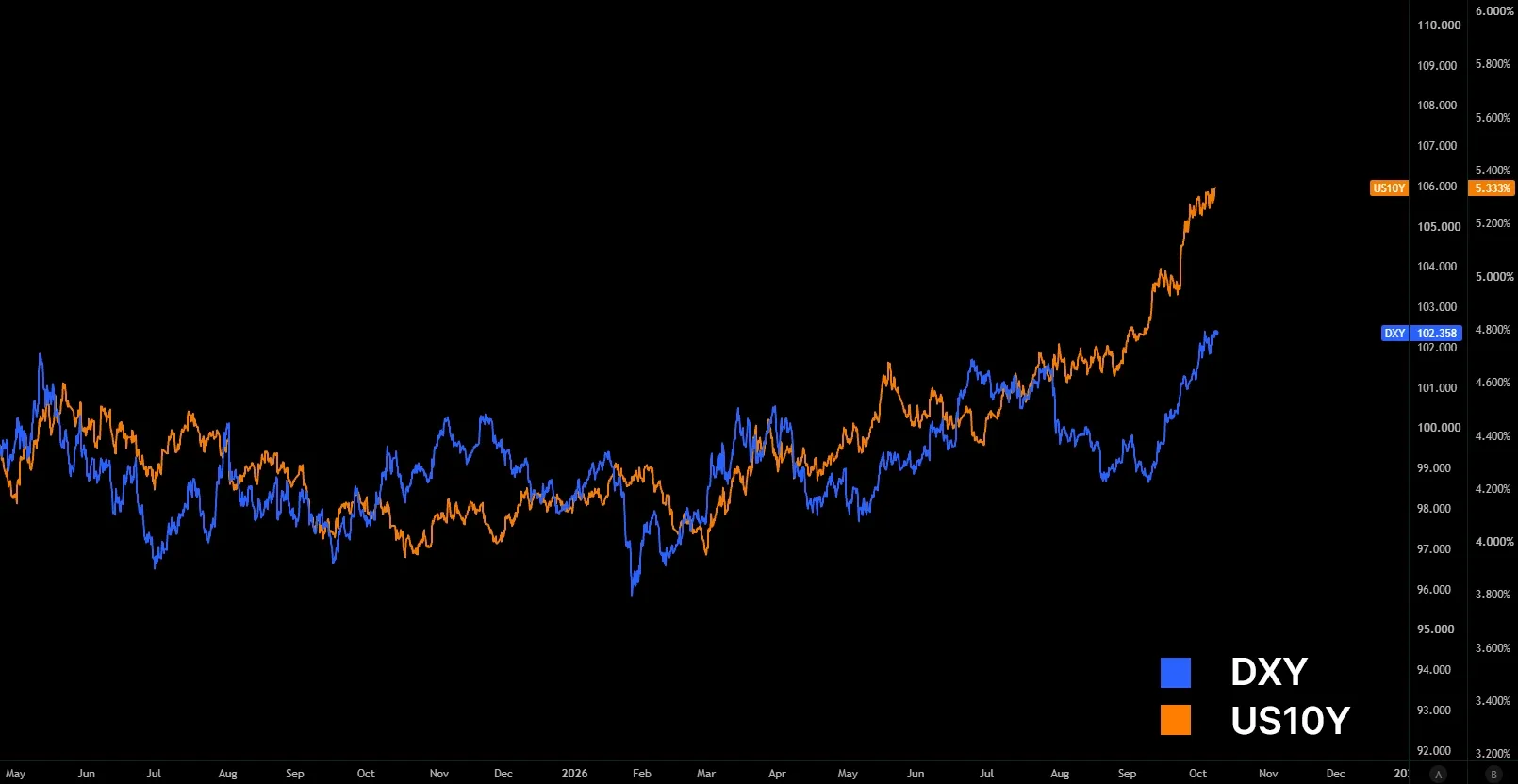
As the chart shows, the DXY and US10Y yields traded in opposite directions in August. The dollar index fell, while Treasury yields traded sideways with upward pressure. The dollar's decline was primarily driven by diminishing expectations of further Fed monetary policy tightening amid challenges with job creation in the US. During August, the likelihood of a rate hike to the 3.75-4.00% range (per FedWatch Tool, chart 2) fell from 67% to 33%. By this time, a series of disappointing Nonfarm Payrolls reports had hit the market, fueling concerns about the necessity of rate hikes and the Fed's ability to lower inflation without harming economic growth.
Chart 2: FedWatch Tool Probability, September
Chart 3: Nonfarm Payrolls US
However, this cooling of hawkish sentiment has not led to a decline in US bond yields. We believe that the current explosive rise in US bond yields is driven not by a single catalyst, but by a combination of factors that has caused widespread reluctance among institutional investors to buy long-term debt. The main factors are:
- The probability of a Fed rate hike in December remains high;
- Corporate debt issuance in the AI sector has increased, shifting capital from Treasuries to higher-yielding corporate debt;
- Inflation risks have re-emerged due to rising oil and petroleum product prices amid the conflict involving Iran;
- Technical spikes in yields have been triggered by a cascade of bond margin calls.
The very fact that this was driven by a combination of factors suggests that the movement lacks the momentum for a further rally, regardless of the data released. This means that a further yield push is certainly possible if new rise factors emerge. However, the emergence of several new factors driving yield rises simultaneously seems unlikely.
These bond prices, even given current inflation factors, are a good basis for purchasing long-term government bond portfolios, despite the likelihood of a further 0.25% rate hike in December. Today, the estimated term premium for 10-year Treasuries is already over 1.08%. This means that demand for government debt will gradually recover, leading to a yield correction. This yield correction, in turn, will translate into a decline in the DXY index.
Today, we're already seeing less-than-favorable data on the US economy. Specifically, the September NFP came in at 29K, with a downward revision for August. As Chart 3 shows, the average three-month NFP reading has remained unchanged at 61K, which is not high enough to support strong hawkish sentiment in the market. Following the September NFP release, the probability of a rate hike in the 4.00-4.25% range decreased from 70.86% to 19.93% (Chart 4). However, the probability of a December rate hike remains quite high at 68.1% at the time of writing.
Chart 4: FedWatch Tool Probability, October
All of the above means that all growth factors are already priced into the DXY, and further dollar appreciation appears possible only if the probability of a rate hike shifts from 4.00-4.25% to 4.25-4.50%, meaning not one, but two rate hikes. So far, we're seeing negative data that is not reflected in the US dollar price due to bond yields remaining at highs. However, this is likely temporary.
Therefore, if signs of a correction in bond yields appear, we expect the DXY dollar index to decline to 100.0 - 100.5.