
Bank of Canada Rate Decision: Why Even a Rate Hike Won't Save the Canadian Dollar?

The Bank of Canada will hold its monetary policy meeting this Wednesday. The consensus forecast expects the central bank to raise the rate to 2.5%. However, even if the Bank of Canada hikes rates, the question remains whether monetary tightening can lead to a further appreciation of the Canadian dollar.
Despite prevailing expectations of a rate hike, many economists remain skeptical, believing the Canadian central bank could pause once again. The primary argument among proponents of a hold is that the growth rate of core inflation lags significantly behind the headline price index. Since February of this year, headline CPI accelerated from 1.8% to 3.1%, while core inflation (excluding energy and food prices) declined over the same period from 2.3% to 2.2%. Thus, despite the domestic fuel price spike driving headline inflation, the growth pace of core CPI remains quite subdued.
Chart 1. Canada CPI & Core CPI
At the same time, the central bank deeply fears that an extended period of high energy prices will inevitably bleed into the broader economy and trigger an acceleration in core inflation. These concerns are well-founded: the three-month moving average of core CPI has shown an upward trajectory for four consecutive months (Chart 1). This factor heightens the risk that a fuel shock will stoke broader inflation in the future. Such risks were already discussed following the September 2, 2026 meeting, when bank leadership warned of intensifying inflationary pressures stemming from expensive oil and trade tariff uncertainties, emphasizing its readiness to adjust policy if necessary.
Chart 2: Ivey PMI, Employment & Prices
Another argument in favor of a Bank of Canada rate hike is that the Canadian economy currently feels quite resilient, without visible signs of a downturn. The Ivey PMI and Employment business activity indices remain above the 50.0 threshold separating expansion from contraction: according to September data, the PMI stands at 58.2, and Employment at 56.5. Meanwhile, the Ivey Prices index surged to 82.8 points (Chart 2). This reflects immense cost pressures: businesses face a cascading surge in procurement prices for raw materials, intermediate goods, and fuel against the backdrop of the Middle East conflict and rising oil prices. As a result, suppliers are passing increased costs further down the value chain onto final goods and services.
The current state of business activity allows the Bank of Canada to raise rates without a high risk of significantly weakening economic growth. Moreover, if the central bank refrains from a rate hike while the U.S. Federal Reserve continues its tightening cycle this year and brings its rate to 4.25%, the yield gap between the U.S. and Canada will widen even further. The expansion of yield spreads will create additional risks for the economy and fundamentally pressure the Canadian dollar.
Chart 3. CAD Index and Brent Crude Dynamics
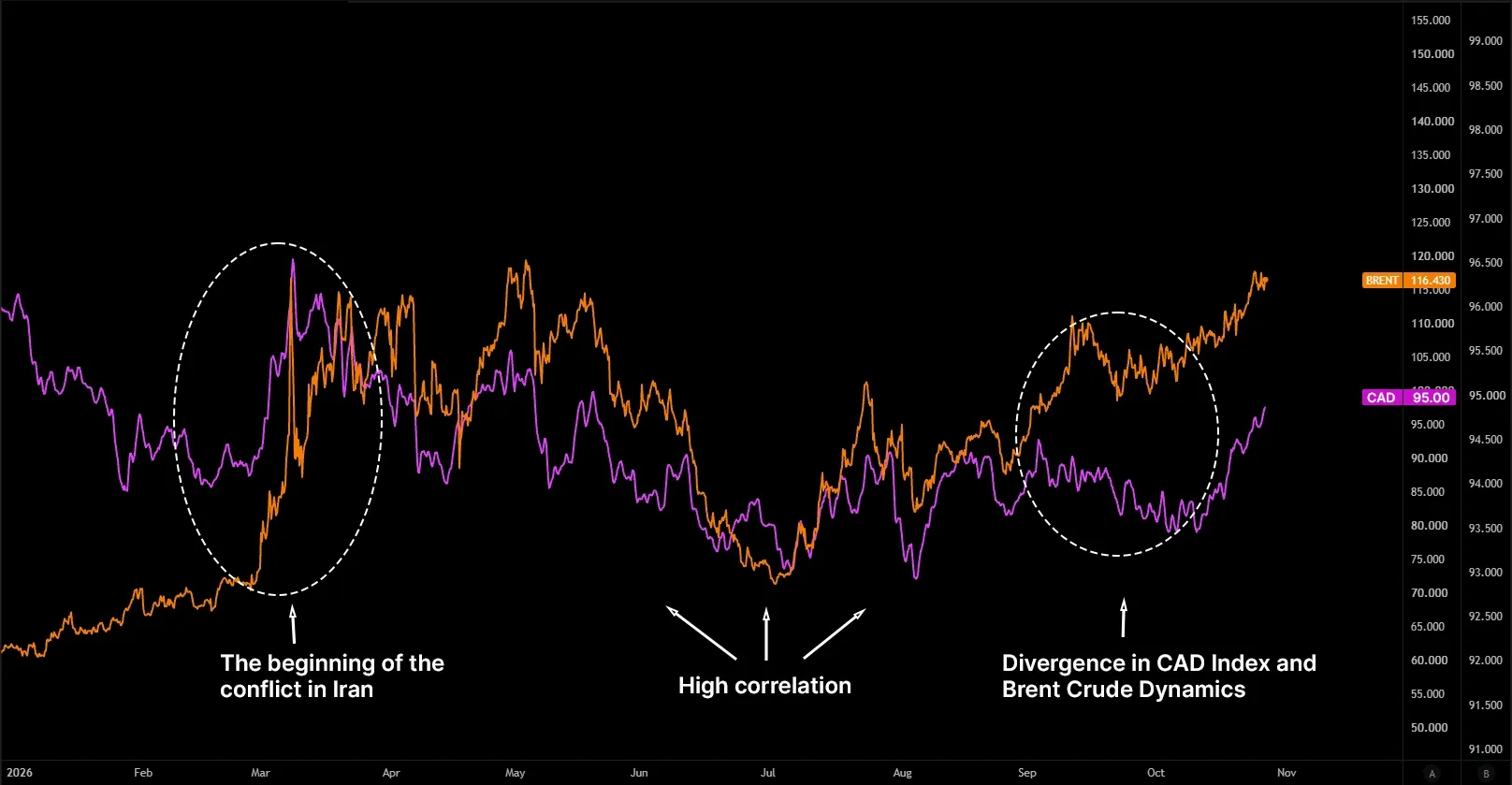
On the other hand, the dynamics of the Canadian dollar since the beginning of the conflict in Iran have been heavily dependent on oil quotations. In September and the first half of October, the trajectory of the Canadian dollar (measured via the SFA Index, a basket of currency pairs featuring the Canadian dollar) and Brent crude temporarily diverged; however, as geopolitical instability around Iran intensified, the Canadian dollar resumed its appreciation in tandem with commodities. The currency found itself driven by two factors simultaneously: monetary tightening expectations and rising oil price risks.
Professional market participants and leading institutions, including the IEA, note that high volatility and structural deficits in the energy market will persist in the future due to depleted buffer stocks and slow infrastructure recovery. Nonetheless, oil prices are near local peaks and highly sensitive to any de-escalation signals. Even if the conflict continues, the possibility of a Brent correction toward levels around $100 per barrel remains. For the Canadian dollar, this will create a double downward effect: falling oil prices pressure the CAD as a commodity currency, and falling oil prices lead to lower inflation expectations and, consequently, reduced monetary tightening expectations.
Ultimately, if the Bank of Canada hikes rates on Wednesday, in current cyclical realities the bank's next step will likely be a prolonged pause. The market will most likely perceive this as a dovish signal, meaning a one-off rate hike cannot become a long-lasting factor for currency strengthening. In the medium term, excluding potential volatility, the Canadian dollar can only grow under the condition of continuous oil appreciation. Any correction in the oil market will lead to a deeper and more extensive decline in the Canadian dollar exchange rate.
_________
Disclaimer: The materials on this website and in these publications are provided for informational and research purposes only and do not constitute individual investment advice. Please review the full text of our Disclaimer.